
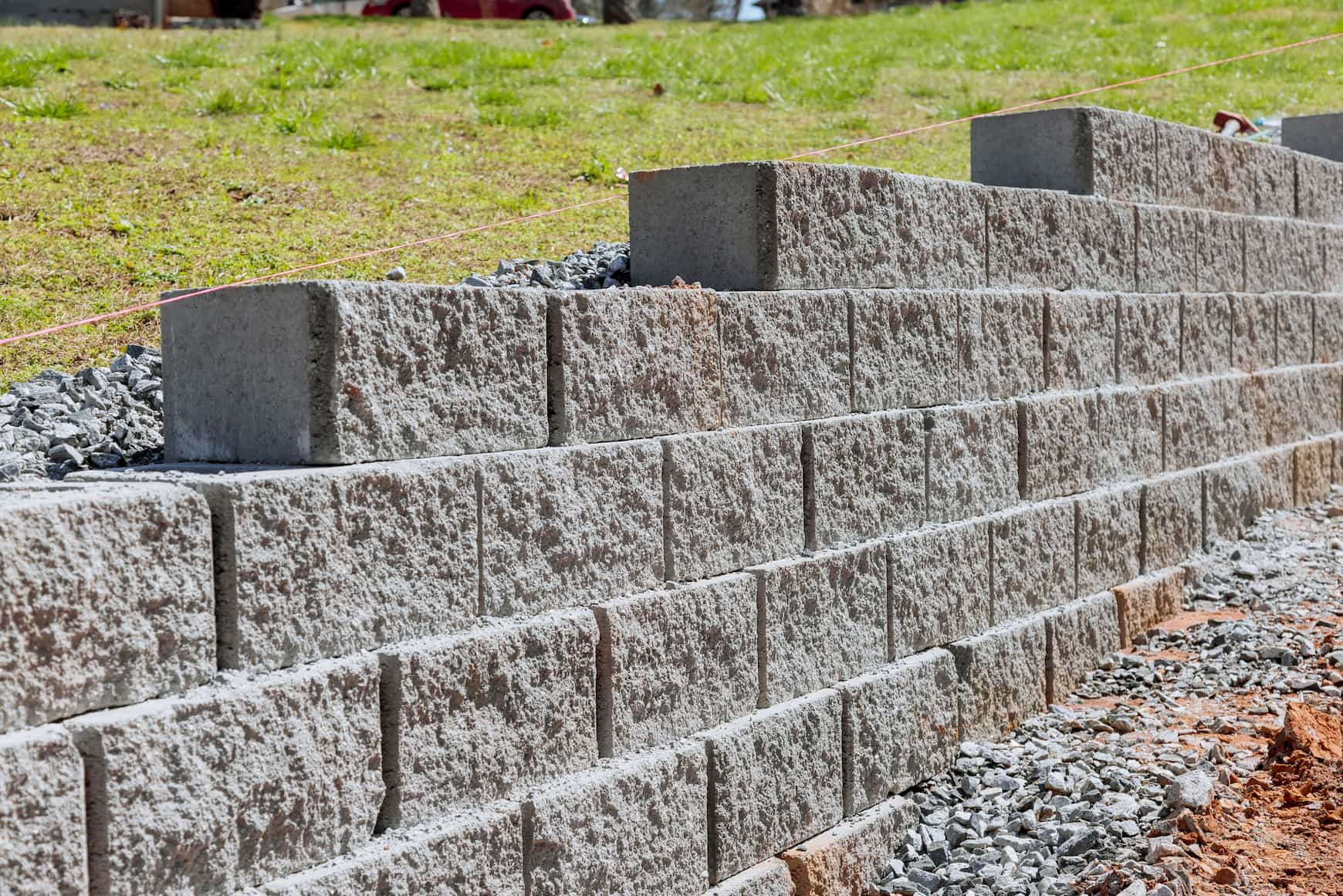
If you have a sloped backyard in Central Jersey, you already know the challenge. Water runs toward the house instead of away from it, the lawn is too steep to mow safely, and half the yard is basically unusable. A retaining wall solves all three problems at once, but the first question every homeowner asks is the same one: what is this actually going to cost?
The honest answer is that retaining wall pricing in New Jersey depends on more variables than most cost calculators let on. Height, material, soil conditions, and whether the wall needs a stamped engineering design all move the number. In this guide we will walk through real price-per-foot ranges for South Brunswick, East Brunswick, Edison, Piscataway, Princeton, Monmouth Junction, and the rest of Middlesex, Monmouth, Somerset, and Union Counties, plus the exact height at which New Jersey law requires a licensed engineer to get involved.
What Drives Retaining Wall Cost in New Jersey
Retaining wall pricing is not a flat rate per foot the way a fence or a stretch of curbing might be. Several factors stack together on every project:
- Wall height, since taller walls need deeper footings, more base material, and often geogrid reinforcement
- Wall length and total square footage of exposed face
- Material choice, whether that is segmental concrete block, natural stone veneer, or poured concrete
- Soil type and drainage conditions on the property
- Site access, since a wall in a fenced backyard reachable only by hand cart costs more to build than one along a driveway
- Whether the wall exceeds the height that triggers a New Jersey engineering requirement
Central Jersey’s clay-heavy soil adds a wrinkle that homeowners in sandier parts of the country do not deal with. Clay holds water, and water sitting behind a wall creates hydrostatic pressure that pushes the structure forward over time. Add in our freeze-thaw winters, where water trapped in the soil expands and contracts through repeated cycles, and you can see why a wall built without proper drainage in New Jersey tends to fail years earlier than one built with it. We will come back to this because it is the single biggest factor separating a wall that lasts twenty years from one that needs to be rebuilt in five.
Retaining Wall Price Per Foot in Central New Jersey
Statewide data puts poured concrete retaining walls in New Jersey at roughly forty five to fifty two dollars per square foot, with segmental block systems typically landing in a similar or slightly lower range once labor and materials are combined. Central Jersey labor rates tend to run above the national average, so homeowners in Middlesex, Monmouth, Somerset, and Union Counties should expect to sit toward the middle or upper end of national ranges rather than the low end.
Here is what that looks like broken out by wall height, which is the factor that moves price the most:
| Wall Height | Typical Cost Per Linear Foot | Engineer Required? |
| Under 2 feet | $40 to $75 | Usually not |
| 2 to 4 feet | $75 to $150 | Depends on municipality |
| 4 to 6 feet (engineered) | $150 to $300+ | Yes, in nearly all NJ towns |
| Tiered or terraced systems | $200 to $400+ per foot of total rise | Often, if combined height exceeds local threshold |
A typical thirty-foot retaining wall in the three to four foot range, which is the most common request we get from homeowners in South Brunswick and East Brunswick, usually lands between six thousand and fourteen thousand dollars installed. Larger structural walls holding back a significant grade change, or multi-tier systems stepping up a steep backyard, commonly run twelve thousand to twenty five thousand dollars or more.
Retaining Wall Cost by Material
Material choice affects both upfront cost and how the wall performs against New Jersey’s clay soil and freeze-thaw cycles over the long run.
| Material | Cost Per Square Foot | Notes for NJ Conditions |
| Segmental concrete block (Unilock, Belgard, Techo-Bloc, EP Henry) | $30 to $50 | Best balance of durability, drainage compatibility, and design flexibility |
| Natural stone veneer | $40 to $65 | Premium look, higher labor cost, excellent longevity when drained properly |
| Poured concrete | $30 to $52 | Strong for engineered structural walls, less design flexibility |
| Pressure-treated timber | $20 to $25 | Lowest upfront cost but shortest lifespan in wet clay soil, typically 10 to 15 years |
We build almost exclusively with segmental block systems from Unilock, Belgard, Techo-Bloc, and EP Henry because they are engineered specifically for retained soil applications, they integrate cleanly with drainage systems, and they hold their structural rating far longer than timber in our soil conditions. Natural stone remains a strong choice when a homeowner wants a specific aesthetic and is willing to invest in it.
When Do You Need an Engineer for a Retaining Wall in New Jersey
This is the question that catches homeowners off guard, because the answer is not a suggestion, it is state law. New Jersey enforces the Uniform Construction Code, which incorporates the International Residential Code section on retaining walls. Under this code, any retaining wall with an exposed height of four feet or more must be designed by a New Jersey licensed professional engineer, with sealed stability calculations submitted before a construction permit is issued.
Four feet is the statewide floor, but many municipalities set stricter local rules. Some towns require an engineer starting at thirty inches. Others count the cumulative height of a tiered or terraced wall system, meaning three two-foot walls stacked up a slope can trigger the same engineering requirement as a single six-foot wall if the town measures total rise rather than individual tiers. A handful of municipalities require a permit application for any retaining wall over just eight inches, even when engineering is not yet required at that height.
In practical terms, this means the rules in Edison may not match the rules in Princeton or Monmouth Junction, even though they are twenty minutes apart. Before we finalize a design, we confirm the exact threshold with the local building and engineering departments so there are no surprises during permit review.
- Walls under 4 feet: usually require a zoning permit only, though some towns require more
- Walls 4 feet and taller: require a sealed engineering design plus a construction permit from the Building and Engineering Departments
- Tiered systems: many towns add up the total height of all tiers on the same slope when deciding if engineering is required
- Safety barriers: New Jersey code generally requires a guard rail or barrier on any wall over 30 inches high
- Engineering fees: budget roughly $500 to $1,500 or more for stamped calculations and drawings on a wall that requires them
Permits Across Middlesex, Monmouth, Somerset, and Union Counties
Every municipality we work in, from South Brunswick and East Brunswick to Piscataway and beyond, requires some form of permit for retaining wall construction once you cross a certain height, and often even below it if the wall sits near a property line or affects drainage onto a neighboring lot. A few things that come up repeatedly in Central Jersey permitting:
- Topographic site plans showing existing and proposed grade are typically required for anything beyond a small garden wall
- Properties near streams, wetlands, or floodplains may fall under NJDEP riparian zone or steep slope protection ordinances, which add review time
- Setback requirements from property lines vary by zone, not just by town
- New Jersey law requires a call to NJ 811 before any excavation begins, regardless of wall height
- Impervious coverage limits in some townships can affect how a wall interacts with drainage and patio square footage on the same lot
Because these rules genuinely differ block by block in some cases, we handle the permit research and, when engineering is required, coordinate directly with a New Jersey licensed engineer as part of the project rather than leaving homeowners to sort it out on their own.
Why Drainage Is the Real Long-Term Cost Driver
Every retaining wall in New Jersey needs a drainage system behind it, and skipping this step is the single most common reason we get called out to rebuild someone else’s wall. Central Jersey’s clay soil does not let water pass through easily, so without a drainage plan, water builds up behind the wall after every heavy rain. That buildup creates hydrostatic pressure, and over successive freeze-thaw cycles each winter, that pressure pushes the wall forward until it bows, cracks, or fails outright.
A proper drainage system typically includes a perforated pipe at the base of the wall, free-draining gravel backfill, and weep holes or outlets that channel water safely away from the structure instead of letting it pool. Installing this correctly adds roughly ten to eighty five dollars or more per linear foot depending on complexity, but it is not an optional upgrade. It is the difference between a wall that holds for twenty five years and one that needs expensive repair work in year five or six.
Hidden Costs Homeowners Often Miss
A few line items catch people off guard when the final quote comes in higher than the number they saw in an online calculator:
- Demolition and haul-away of an old, failing wall, typically $15 to $30 per linear foot
- Excavation and disposal of excess soil, especially on sites with heavy clay
- Limited site access, since a backyard reachable only through a gate often requires hand-carrying material rather than machine access
- Grading, topsoil, and sod or seed restoration after construction wraps up
- Engineering review and permit turnaround time, which can add several weeks to a project timeline on walls over four feet
How a Retaining Wall Adds Value to Your Property
Beyond solving a grading or erosion problem, a well-built retaining wall is one of the more effective ways to add usable square footage and resale value to a Central Jersey property. A sloped, unusable side yard becomes a flat area for a patio, a garden, or a play space. Water that used to pool near the foundation gets redirected safely away from the house, which protects one of the most expensive parts of any home to repair. Tiered walls can turn a steep backyard into a series of usable outdoor rooms, which pairs naturally with a paver patio or a new walkway tying the levels together.
Real estate appraisers and landscape industry data consistently point to hardscaping improvements, retaining walls included, as projects that return a meaningful share of their cost at resale while also making the property more livable in the meantime. In a region like ours, where many homes sit on lots with noticeable grade change, a properly engineered wall is often what unlocks the rest of a backyard renovation.
Outdoor Hardscape’s Retaining Wall Process in Central New Jersey
We design and build retaining walls using segmental block systems from Unilock, Belgard, Techo-Bloc, and EP Henry, chosen based on your soil conditions, the height of the wall, and the look you want for the property. Our process includes:
- An on-site consultation where we measure grade change, assess drainage patterns, and identify whether your project will need engineering under local code
- Coordination with a New Jersey licensed engineer for any wall that meets or exceeds the applicable height threshold in your municipality
- Full permit handling with your township’s Building and Engineering Departments
- A drainage plan built into every wall, not offered as an afterthought
- Integration with related projects like patio design and installation, walkways and paths, and other retaining wall work happening on the same property
We serve homeowners throughout Kendall Park, South Brunswick, East Brunswick, Edison, Piscataway, Princeton, Monmouth Junction, and the surrounding towns across Middlesex, Monmouth, Somerset, and Union Counties.
Getting an Accurate Retaining Wall Quote
Online calculators can give you a ballpark, but the only way to get a real number for your property is a site visit. Grade, soil, access, and your township’s specific engineering threshold all factor into the final price, and we walk through each of those with you before putting together a proposal.
If you are planning a retaining wall project anywhere in Middlesex, Monmouth, Somerset, or Union County, reach out to Outdoor Hardscape for a free consultation. Call us at 908-294-6296 or email edoutdoor790@gmail.com to schedule a site visit and get a written quote for your project.
Frequently Asked Questions
Q: How much does a retaining wall cost per foot in New Jersey?
A: Most New Jersey retaining walls run between $40 and $150 per linear foot for walls under four feet, and $150 to $300 or more per linear foot once a wall requires engineering. Segmental block installed costs typically fall between $30 and $50 per square foot, with Central Jersey labor rates running slightly above the national average.
Q: Do I need a permit to build a retaining wall in NJ?
A: Most New Jersey municipalities require at least a zoning permit for retaining walls, and some require a permit for any wall over eight inches tall. Walls four feet or taller require a construction permit along with a sealed engineering design, so it is worth confirming your township’s exact rule before starting work.
Q: At what height does a retaining wall require an engineer in NJ?
A: New Jersey’s Uniform Construction Code requires a licensed professional engineer for any retaining wall with an exposed height of four feet or more. Some municipalities set a lower local threshold, such as thirty inches, or count the combined height of tiered walls on the same slope, so local code should always be confirmed.
Q: What is the cheapest retaining wall material?
A: Pressure-treated timber has the lowest upfront cost, typically $20 to $25 per square foot, but it holds up poorly in New Jersey’s clay soil and freeze-thaw winters, often lasting only 10 to 15 years. Segmental concrete block offers a similar or slightly higher price with significantly better long-term durability.
Q: How long does a retaining wall last?
A: A properly built and drained segmental block or natural stone retaining wall in New Jersey can last 25 to 50 years or more. Walls that skip proper drainage often fail within 5 to 10 years due to hydrostatic pressure and freeze-thaw damage.
Q: Can I build a retaining wall myself in New Jersey?
A: You can build a small garden wall under any local permit threshold yourself, but most municipalities require a permit and, for walls four feet and taller, a sealed engineering design that a homeowner cannot self-certify. DIY walls without proper drainage are also the most common cause of failures we get called out to fix.
Q: Does a retaining wall add value to my home?
A: Yes. A retaining wall that creates usable flat space, controls erosion, and protects your foundation from water damage is generally considered a value-adding hardscape improvement, and it often opens up the rest of the yard for a patio or garden that adds further value.
Q: How much does drainage add to the cost of a retaining wall?
A: A proper drainage system, including gravel backfill, perforated pipe, and weep holes, typically adds $10 to $85 or more per linear foot depending on complexity. It is not optional in New Jersey’s clay soil and should always be included in your quote rather than treated as an upgrade.