Your driveway works harder than almost any other surface on your property. It carries thousands of pounds of vehicle weight every day, takes the worst of snow shovels and ice melt every winter, and shapes the first impression anyone gets of your home. Here in Central New Jersey, it also has to survive clay-heavy soil, dozens of freeze-thaw cycles each season, and the kind of summer downpours that can wash out a poorly built base.
Choosing between a paver driveway, asphalt, and poured concrete is one of the most common questions homeowners in South Brunswick, East Brunswick, Edison, and Princeton bring to us. All three materials can work. They just perform very differently once New Jersey weather gets involved. This guide walks through real costs, lifespans, maintenance demands, and home value impact so you can pick the right surface the first time.
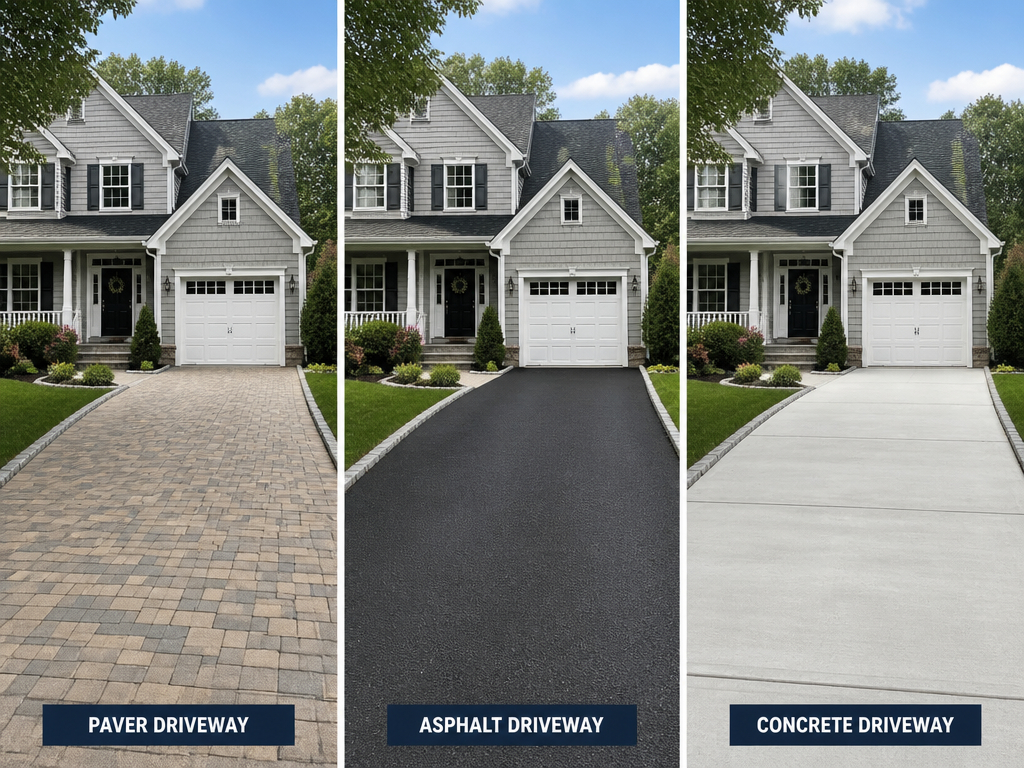
For most New Jersey homes, an interlocking paver driveway offers the best long-term value. Pavers resist freeze-thaw cracking better than poured concrete, last roughly twice as long as asphalt, and allow spot repairs that are invisible once finished. Asphalt is the cheapest option upfront but needs the most ongoing care. Poured concrete sits in the middle on price yet is the most vulnerable of the three to cracking in our climate. If your budget allows it, pavers usually cost the least per year of service.
Why Driveway Material Matters More in New Jersey
A driveway that performs beautifully in Arizona can fail fast in Middlesex County. Two local conditions do most of the damage.
- Clay soil. Much of Central New Jersey sits on dense clay that holds water. When that water freezes, the soil expands and pushes upward against whatever is sitting on it. When it thaws, the ground settles back down. Rigid surfaces take that movement badly.
- Freeze-thaw cycles. Our region swings above and below freezing dozens of times each winter. Water works into every hairline crack, freezes, expands by about nine percent, and pries the crack wider. Repeat that forty times a season and small flaws become real failures.
The frost line in New Jersey runs about 36 inches deep, which is why base preparation matters as much as the surface material you choose. Any driveway is only as good as what sits underneath it. That is true for pavers, asphalt, and concrete alike, and it is the single biggest difference between a driveway that lasts decades and one that fails in five years.
Paver Driveways: Built to Move With New Jersey Ground
A paver driveway is made of individual concrete or clay units set over a deep, compacted gravel base with a bedding layer of sand. The joints between pavers are filled with polymeric sand, and the whole field is locked in place with edge restraints. That structure is the secret to their durability. Because every unit can shift a hair independently, the surface flexes with frost heave instead of fighting it.
Quality driveway pavers from manufacturers like Unilock, Belgard, Techo-Bloc, and EP Henry are factory cured to compressive strengths around 8,000 psi or higher, which is more than double typical poured concrete. On a driveway we excavate deeper and compact a thicker gravel base than we would for a patio, because vehicle loads demand it. Done right, that base is what carries your cars, not the pavers alone.
What pavers do well
- Lifespan of 30 to 50 years with basic care, the longest of the three materials
- Joints flex through freeze-thaw cycles instead of cracking
- Individual pavers can be lifted and reset after a stain, a utility repair, or minor settling, with no visible patch
- Huge design range: colors, patterns, borders, and aprons that match your walkway or patio
- Permeable paver systems let rainwater drain through the joints, which helps with township impervious coverage limits and reduces puddling and ice sheets
What to weigh before choosing pavers
- Highest upfront cost, typically $15 to $30 per square foot installed in Central New Jersey
- Installation quality matters enormously; a thin or poorly compacted base will settle no matter how good the pavers are
- Joint sand needs topping up every few years, and weeds can appear in neglected joints
Asphalt Driveways: Affordable Upfront, Demanding Over Time
Asphalt is the familiar blacktop surface across New Jersey, and there are good reasons for that. It installs quickly, usually in a day or two, and it carries the lowest upfront price of the three, generally $7 to $13 per square foot in our area. Its dark color also helps snow and ice melt a little faster, and it tolerates plowing well.
The tradeoff is maintenance. Asphalt is a petroleum product that oxidizes and dries out from the day it is placed. To keep it flexible and looking sharp, it needs sealcoating every two to three years plus crack filling in between. Skip that routine and the surface fades to gray, cracks spread, and potholes follow. Summer heat softens asphalt enough that kickstands, trailer jacks, and even sharp turns from tires can leave marks, and oil or gas drips will eat into the surface. When a section does need patching, the repair is always visible.
With diligent care, an asphalt driveway typically lasts 15 to 20 years in New Jersey before it needs resurfacing or full replacement. It is a sensible choice when budget is the deciding factor or when you need a very long rural driveway covered economically. Just go in with realistic expectations about the upkeep schedule.
Concrete Driveways: A Clean Look With a Cracking Problem
Poured concrete offers a bright, tidy appearance and a hard surface that resists heat, oil stains, and tire scuffing better than asphalt. Installed cost in Central New Jersey usually runs $10 to $18 per square foot for standard gray, and $18 to $28 or more for stamped and colored finishes. Under ideal conditions, a concrete driveway can serve 20 to 30 years.
The problem is that New Jersey does not offer ideal conditions. Concrete is a rigid slab sitting on soil that moves every winter. Contractors saw control joints into the surface hoping cracks will follow those straight lines, but on clay soil with repeated frost heave, cracks eventually go where they want. Once water enters a crack and freezes, the damage compounds each season. Rock salt and many de-icers make things worse by causing the surface to flake and pit, a failure called spalling.
Repair options are limited. Caulked cracks and patched sections never match the surrounding slab, and a badly cracked driveway usually means full removal and replacement. Stamped concrete shares all of these weaknesses at a price point that overlaps with pavers, which is why we rarely recommend it for driveways in our climate. If you love the look of stamped concrete, pavers deliver a similar effect with far better cold-weather performance.
Side-by-Side Comparison
| Factor | Paver Driveway | Asphalt | Poured Concrete |
|---|---|---|---|
| Installed Cost (per sq ft) | $15 to $30 | $7 to $13 | $10 to $18 ($18 to $28 stamped) |
| Typical Lifespan in NJ | 30 to 50 years | 15 to 20 years | 20 to 30 years, cracking often sooner |
| Freeze-Thaw Performance | Excellent, joints flex with the ground | Fair, cracks and potholes form over time | Poor to fair, rigid slabs crack |
| Maintenance | Occasional joint sand top-up, optional sealing | Sealcoating every 2 to 3 years, crack filling | Joint sealing, crack repair, cautious de-icing |
| Repairs | Lift and reset individual pavers; invisible when done | Patches always visible | Patches and caulked cracks always visible |
| Design Options | Extensive colors, patterns, borders | Black only | Gray, or stamped and colored at a premium |
| Drainage Options | Permeable systems available | Impervious | Impervious |
| Curb Appeal and Resale | Strongest | Modest | Moderate |
Cost vs. Value: Thinking in Cost Per Year, Not Just Price Per Foot
Upfront price tells only part of the story. Spread the numbers across each material’s realistic lifespan and the picture changes. An asphalt driveway at $10 per square foot that lasts 18 years with regular sealcoating costs more per year of service than it first appears once you add roughly $400 to $700 for each sealcoating cycle. A paver driveway at $22 per square foot that serves 40 years with minimal upkeep often works out to the lowest true annual cost of the three.
There is also the resale side. Real estate agents across Middlesex and Somerset Counties will tell you that a cracked or crumbling driveway is one of the first things buyers notice and one of the most common negotiation points during inspection. A paver driveway does the opposite. It elevates curb appeal the moment someone pulls up, it signals that the home has been cared for, and it removes a five-figure future expense from the buyer’s mental math. Few exterior upgrades communicate quality as quickly.
New Jersey Rules and Site Factors to Check Before You Build
Before any driveway project in Central New Jersey, a few local requirements deserve attention.
- Municipal permits. Requirements vary town by town. Replacing a driveway in kind may only need a zoning review in some municipalities, while widening it, changing the material, or altering drainage can trigger permits in South Brunswick, East Brunswick, Edison, and elsewhere. A quick call to your zoning office settles it.
- Impervious coverage limits. Most townships cap the percentage of a lot that can be covered by surfaces water cannot pass through. If your property is near its limit, a permeable paver driveway may be the only way to expand, since many towns credit permeable systems differently than solid asphalt or concrete.
- NJ 811. State law requires a utility markout before excavation. Any reputable contractor handles this call before digging begins.
- Drainage and grading. A driveway should shed water away from your foundation and garage. If your current driveway puddles or sends runoff toward the house, the rebuild is the moment to fix it with proper pitch, a channel drain, or a connected French drain or catch basin.
So Which Driveway Is Right for Your Home?
- Choose asphalt if your top priority is the lowest upfront cost, you have a very large area to cover, and you are comfortable committing to sealcoating every two to three years.
- Choose poured concrete if you prefer its bright, uniform look, your site has stable, well-drained soil, and you accept that cracks are likely over time and repairs will show.
- Choose pavers if you want the longest lifespan, the strongest curb appeal, invisible repairs, and the best performance through New Jersey winters, and you are ready to invest more on day one for decades of low-cost service.
For most homeowners we work with from Monmouth Junction to Piscataway, the decision comes down to time horizon. If you plan to stay in your home for more than a handful of years, or you want the driveway to help sell it, pavers earn their premium.
How Outdoor Hardscape Builds Driveways That Last
At Outdoor Hardscape, driveways are an extension of what we do every day across Central New Jersey: patios, walkways and paths, retaining walls, and the drainage systems that protect them. We are a fully insured hardscaping and landscaping contractor based in Kendall Park, serving Middlesex, Monmouth, Somerset, and Union Counties.
Every paver driveway we build starts with the part you never see. We excavate to the depth the site demands, compact the gravel base in layers, and set proper pitch so water moves away from your home. Then we install premium pavers from Unilock, Belgard, Techo-Bloc, or EP Henry, lock the field with edge restraints, and finish the joints with polymeric sand. If your property has drainage trouble, we can integrate a French drain or catch basin into the project so the new driveway and your foundation stay protected. We can also tie the driveway into a matching walkway, front steps, or an apron and border design that pulls the whole front yard together.
Ready to see what your driveway could look like? Call us at 908-294-6296 for a free on-site consultation, or send us a note through the contact form on our website and we will walk the property with you, talk through materials, and give you a clear, honest quote. Ask about our current offers on the discounts page while you are there. Whether you are in South Brunswick, East Brunswick, Edison, Piscataway, or Princeton, we are close by and happy to help you compare options with real numbers for your specific site.
Frequently Asked Questions
Q: Is a paver driveway better than asphalt in New Jersey?
A: For long-term performance, yes. Pavers flex with New Jersey’s freeze-thaw cycles instead of cracking, and they last roughly twice as long as asphalt. Asphalt wins only on upfront price, and that gap narrows once you factor in sealcoating every two to three years.
Q: How much does a paver driveway cost in New Jersey?
A: Most paver driveways in Central New Jersey fall between $15 and $30 per square foot installed, depending on the paver line, base depth, and site conditions. A typical two-car driveway of 600 to 750 square feet usually lands between $10,000 and $22,000. Tear-out of an old surface and drainage work can add to that range.
Q: How long does each type of driveway last?
A: A properly built paver driveway lasts 30 to 50 years, asphalt typically lasts 15 to 20 years with regular sealcoating, and poured concrete lasts 20 to 30 years under ideal conditions. In New Jersey’s climate, concrete often shows cracking well before the end of that range.
Q: Which driveway material handles freeze-thaw cycles best?
A: Interlocking pavers handle freeze-thaw cycles best because the sand-filled joints let each unit move slightly as the ground expands and contracts. Poured concrete is rigid and cracks under that same movement, while asphalt softens in summer heat and cracks in winter cold.
Q: Do paver driveways add value to a home?
A: Yes. A paver driveway improves curb appeal immediately and signals quality to buyers, which matters in competitive Central New Jersey markets. Because it will not need replacement for decades, it also removes a future expense that buyers often negotiate over with aging asphalt or cracked concrete.
Q: Do I need a permit to replace a driveway in New Jersey?
A: It depends on your town. Many Central New Jersey municipalities require a zoning or engineering permit when you expand a driveway, change the material, or alter drainage, and most enforce impervious surface coverage limits. Always confirm with your local zoning office, and call NJ 811 before any digging begins.
Q: Which driveway is easiest to maintain?
A: Pavers require the least ongoing work: sweep, rinse, and top up joint sand every few years, with sealing optional. Asphalt demands sealcoating every two to three years plus crack filling, and concrete needs joint sealing and careful de-icer choices to avoid surface spalling.
Q: Can pavers be installed over an existing asphalt or concrete driveway?
A: Sometimes, but it is rarely the best approach for driveways. An overlay depends on the old surface being sound, and it can trap water and raise the finished height against garage slabs and walkways. A full-depth installation over a properly compacted gravel base is what gives a paver driveway its 30-plus year lifespan.
A driveway is a decision you live with every single day for decades. Choose the material that fits your budget, your timeline, and New Jersey’s climate, and make sure whoever builds it treats the base with the respect it deserves. If you would like an experienced local team in your corner, Outdoor Hardscape is ready when you are.