
Every spring, we get the same phone call. A homeowner in South Brunswick or East Brunswick walks outside after the snow melts and notices a corner of their patio has dropped an inch or two. Water is pooling near the back door. A few pavers rock when you step on them. They want to know one thing: do I need to repair this, or does the whole thing need to come out?
After years of digging up patios across Middlesex, Somerset, Monmouth, and Union Counties, we can tell you that sinking pavers are almost never a random accident. There is always a reason, and in Central Jersey, that reason usually traces back to what is happening below the surface, not the pavers themselves. This guide walks through why patios sink here specifically, how to tell whether your patio needs a repair or a full rebuild, and what each option actually involves.
Why Paver Patios Sink in Central New Jersey
Every region has its own soil and climate challenges, and Central New Jersey has a few that make patios especially prone to settling if they were not built correctly the first time.
Clay-Heavy Soil
Much of Middlesex and Somerset County sits on dense clay subsoil. Clay holds water instead of letting it drain through, which means the ground beneath a patio can swell when it is saturated and shrink when it dries out. That constant expansion and contraction slowly works pavers loose from their original position, especially at the edges and low points of the patio.
Freeze-Thaw Cycles
New Jersey winters put every hardscape through repeated freezing and thawing. Water that gets trapped in the base material freezes, expands, and pushes the aggregate out of place. When it thaws, small voids are left behind. Repeat that cycle for a few winters and you end up with soft spots that eventually become visible dips in the patio surface.
A Base That Was Never Built Deep or Dense Enough
This is the single biggest cause of sinking patios we see on service calls. A patio in our climate needs a properly compacted base of crushed stone, typically four to six inches for a pedestrian patio, installed in lifts and compacted with a plate compactor, not just spread and left alone. When installers skip the compaction step, use unwashed or loose gravel, or bury topsoil and organic debris under the base, that material keeps settling for years after installation. The pavers on top simply follow the ground down.
Poor Drainage and Grading
A patio should slope away from the house at roughly an eighth of an inch per foot. When the grading is flat or, worse, pitched toward the home, water sits on the surface and works its way into the joints. Over time it washes out the bedding sand and the base beneath it, creating hollow pockets that the pavers eventually fall into.
Downspouts and Gutters Dumping Water Near the Patio
We inspect a lot of “mystery” sinking that turns out to have a simple explanation: a downspout emptying directly onto or next to the patio edge. That concentrated water erodes the base from one corner outward, which is why so many sinking patios show the worst damage closest to the house.
Tree Roots and Organic Material Under the Base
If a patio was installed over old sod, mulch, or tree roots instead of properly excavated soil, that organic material eventually decomposes. As it breaks down, it leaves gaps beneath the base layer, and the patio sinks into the space that used to be filled with living material.
Warning Signs Your Patio Is Telling You Something
Most patio failures do not happen overnight. They show up gradually, and catching them early is what keeps a simple repair from turning into a full rebuild. Watch for:
- A section of pavers that has visibly dropped compared to the surrounding area
- Puddles that linger on the surface more than a few hours after rain
- Pavers that rock, shift, or feel loose underfoot
- Widening gaps between pavers or joint sand that keeps washing out
- Cracked pavers clustered in one area, which usually points to a void underneath
- Water pooling against the foundation or siding near the patio edge
If you are only seeing one or two of these signs in a small area, you are likely still in repair territory. If several of these are happening across a large portion of the patio, that is usually a sign the base has failed more broadly.
Repair vs. Rebuild: How to Know Which One You Need
This is the question every homeowner really wants answered, and the honest response is that it depends on how much of the patio is affected and why.
When a Repair Makes Sense
A repair is the right call when the problem is contained. If one section near a downspout has sunk while the rest of the patio is level and solid, we can pull up that section, correct the base, address the drainage cause, and reset the same pavers. Repairs also make sense for isolated cracked pavers, minor edge settling, or joint sand that has washed out from a patio that is otherwise structurally sound. A well-executed spot repair blends in almost seamlessly and restores the patio’s function without the cost of starting over.
When a Full Rebuild Is the Smarter Investment
A rebuild becomes the better option when the sinking is widespread, when the original base was clearly installed incorrectly across the whole footprint, or when the patio is more than 10 to 15 years old and showing multiple failure points at once. In these cases, patching one area is a temporary fix. The same base problems that caused the first section to fail are still sitting under the rest of the patio, and new low spots tend to appear within a season or two of a partial repair. If your patio has settled in three or more separate areas, has consistently poor drainage across its whole surface, or was installed without proper base depth in clay soil, rebuilding gives you a foundation that is actually built for our conditions.
| Factor | Repair | Rebuild |
| Extent of sinking | Localized, one to two spots | Widespread, three or more areas |
| Patio age | Newer patio, isolated failure | Often 10+ years, multiple failure points |
| Underlying base | Sound in unaffected areas | Compromised across the footprint |
| Drainage issue | Single identifiable source | Chronic, whole-patio grading problem |
| Typical cost range | Lower, targeted labor and material | Higher, full excavation and new base |
| Long-term outcome | Restores affected section | Resets the entire patio’s lifespan |
What a Professional Patio Repair Involves
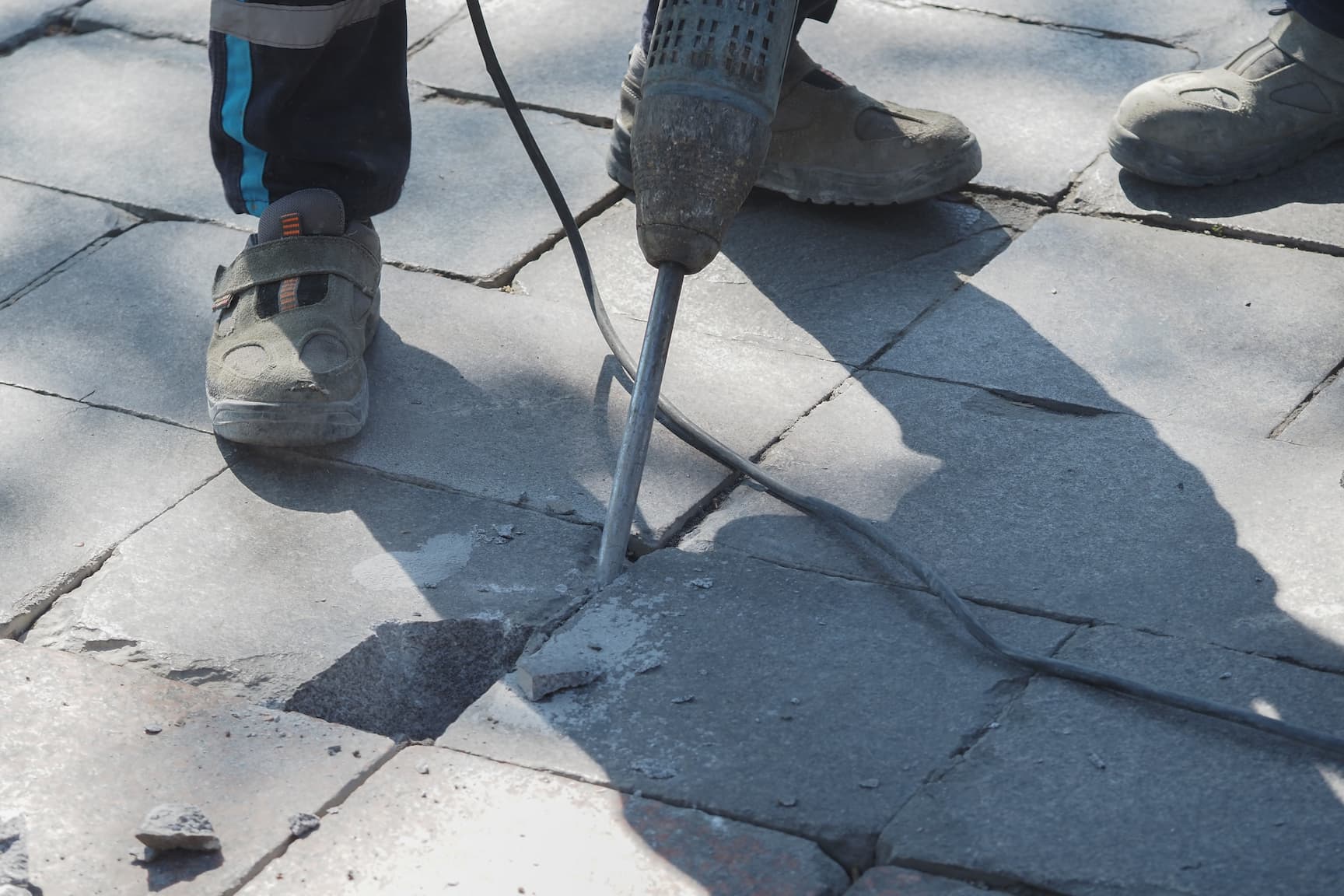
A proper repair is not just lifting pavers and dropping them back in place. Our process removes the affected pavers and sets them aside, excavates down to the compromised base material, and identifies the root cause, whether that is a drainage issue, an eroded downspout path, or a soft spot from old organic material. We install new crushed stone base in compacted lifts, correct the grading so water moves away from the structure, and reset the original pavers with fresh bedding sand and polymeric sand in the joints. Because we are reusing your existing pavers, repairs typically take one to three days depending on the size of the affected area.
What a Full Patio Rebuild Involves
A rebuild starts with full removal of the existing pavers and excavation of the entire base to the appropriate depth for our climate, generally accounting for the local frost line and soil conditions. We install a properly compacted aggregate base across the whole footprint, add geotextile fabric in areas with clay soil to separate the base from the subgrade, and build in the correct slope from the start. From there we either reset your original pavers, assuming they are in good condition, or install new pavers if you are ready for a style refresh from brands like Unilock, Belgard, Techo-Bloc, or EP Henry. A rebuild is a bigger project, usually spanning several days depending on square footage, but it addresses the problem at its source rather than treating a symptom.
Cost Considerations for Central New Jersey Homeowners
Pricing depends heavily on the scope of the work, but homeowners in our service area can generally expect targeted paver repairs to run in the range of the low tens of dollars per square foot, since the labor of excavating, correcting the base, and resetting existing pavers is the main cost rather than new material. A full rebuild costs more because it involves complete removal, disposal, new base material, and either resetting or replacing the paver surface across the entire patio. For context, a newly installed paver patio in Central Jersey typically runs in the twenty to forty dollar per square foot range depending on material and site conditions, and a rebuild often falls somewhere in that same territory since it is essentially a new installation using your existing footprint. We always provide a written, itemized estimate after an on-site evaluation so you know exactly what you are paying for and why.
How Fixing a Sinking Patio Adds Value to Your Home
A sinking patio is not just a cosmetic issue. Uneven pavers are a tripping hazard, which matters both for your family’s safety and for liability if you have guests over regularly. Water pooling near your foundation can contribute to basement moisture and long-term structural issues that are far more expensive than a patio repair. On the value side, outdoor living spaces consistently rank among the improvements that Central Jersey buyers notice during a home sale, and a patio that is visibly settling or holding water is an easy point of negotiation for a buyer’s inspector to flag. Addressing the problem correctly, whether through repair or rebuild, protects the investment you already made in your outdoor space and keeps your patio functioning as an asset instead of a liability.
Preventing Future Sinking
Once your patio is repaired or rebuilt, a few habits go a long way toward keeping it that way. Make sure downspouts discharge well away from the patio edge, ideally with an extension or buried drain line. Keep an eye on joint sand and top it off with polymeric sand when it starts to thin, since intact joints keep water from working its way into the base. Avoid planting large trees close to the patio edge where roots can eventually disturb the base, and address any standing water you notice within 24 to 48 hours of a storm rather than waiting to see if it resolves on its own. If you are ever unsure whether something you are seeing is normal settling or the start of a bigger problem, a quick inspection is always cheaper than waiting.
Why Central New Jersey Homeowners Trust Outdoor Hardscape
We are based in Kendall Park and have spent years repairing and rebuilding patios throughout South Brunswick, East Brunswick, Edison, Piscataway, Princeton, Monmouth Junction, and the surrounding Middlesex, Somerset, Monmouth, and Union County communities. We understand how our clay soil and freeze-thaw winters behave differently than a generic national repair guide would suggest, and we build every repair and rebuild to hold up against those specific conditions. Whether your patio needs a targeted fix or a complete rebuild, we start with an honest, on-site evaluation and give you a clear recommendation, not an automatic upsell to the most expensive option.
Ready to stop guessing about your sinking patio? Call Outdoor Hardscape at 908-294-6296 or reach us through outdoorhardscape.com to schedule a free on-site evaluation. We will walk your property with you, explain exactly what is happening underneath your patio, and give you a straightforward repair or rebuild recommendation with transparent, itemized pricing.
Frequently Asked Questions
Q: Why is my paver patio sinking in one specific spot?
A: Localized sinking usually points to a concentrated water source nearby, like a downspout or poor grading in that section, or a pocket of organic material that broke down under the base. A focused inspection of that area will typically identify the exact cause.
Q: Can a sinking paver patio be repaired without replacing all the pavers?
A: Yes, in most cases the original pavers can be lifted, set aside, and reused once the base underneath has been corrected. This is standard practice for localized repairs and keeps the cost well below a full rebuild.
Q: How long does a paver patio repair take?
A: A targeted repair for a smaller affected area typically takes one to three days, depending on the size of the section and whether drainage corrections are needed. A full rebuild takes longer since it involves excavating and rebuilding the entire base.
Q: Is a sinking patio a sign of a bigger foundation problem?
A: Not usually. Patio settling is almost always related to the patio’s own base and drainage, not the home’s foundation. That said, if water is pooling against your house because of the sinking, it can contribute to foundation moisture issues over time, which is another reason to address it promptly.
Q: How much does it cost to fix a sinking paver patio in Central New Jersey?
A: Costs vary based on the size of the affected area and whether a repair or full rebuild is needed, with repairs generally costing less per square foot than a full rebuild since existing pavers are reused. An on-site evaluation is the only way to get an accurate number for your specific patio.
Q: Do I need a permit to repair or rebuild a paver patio in New Jersey?
A: Many municipalities in Central Jersey do not require a permit for like-for-like patio repairs, but rebuilds, especially those that change the footprint or add impervious coverage, sometimes do depending on your town’s ordinances. We handle the permit question as part of our evaluation so you do not have to research your local rules yourself.
Q: What is the best way to prevent a paver patio from sinking again?
A: Proper drainage is the single biggest factor. Keeping downspouts directed away from the patio, maintaining polymeric sand in the joints, and making sure the patio was built with a properly compacted base to begin with will prevent most future settling.
If your patio is sinking, pooling water, or just does not feel as solid as it used to, reach out to Outdoor Hardscape for a free evaluation. Call us at 908-294-6296 or send a message through outdoorhardscape.com, and we will walk your property with you, explain exactly what is happening underneath your patio, and give you a straightforward repair or rebuild recommendation with transparent pricing.