
Standing water in your yard is more than just a nuisance. It kills grass, weakens soil, invites mosquitoes, and over time it can work its way toward your foundation. If you live in Central New Jersey, particularly in towns like South Brunswick, Edison, Piscataway, Monmouth Junction, or Princeton, you already know that our clay-heavy soils and unpredictable spring rains make proper drainage a real priority.
Two of the most common drainage solutions homeowners ask about are catch basins and French drains. Both move water away from problem areas, but they work in completely different ways and they are designed to solve different types of problems. Choosing the wrong one wastes money and may leave you with the same soggy yard come spring.
This guide breaks down exactly how each system works, when to use one over the other, and what to expect if you decide to have one installed. If you are not sure which solution fits your yard, our team at Outdoor Hardscape serves homeowners across Middlesex, Monmouth, Somerset, and Union Counties and offers free consultations to help you figure out the right call.
What Is a French Drain?
A French drain is a subsurface drainage system designed to redirect groundwater and surface water away from a specific area. The basic construction involves digging a trench, lining it with landscape fabric, filling the bottom with gravel, and running a perforated pipe through it. The whole thing gets topped with more gravel and covered.
Water seeps down through the gravel, enters the perforated pipe through small holes or slots, and then flows along the pipe toward a designated outlet, whether that is the street, a dry well, a storm drain easement, or a low point on your property away from structures.
When a French Drain Makes Sense
French drains are best suited for situations where water is seeping up from below or draining very slowly through saturated soil. Here are the most common scenarios where this system shines:
- Water pools in the lawn after moderate rain and takes hours or days to absorb
- You have a soggy low spot in the yard with no obvious collection point
- Water is migrating toward your foundation or crawl space
- A slope on your property is directing subsurface water toward your home
- You want to protect a retaining wall from hydrostatic pressure buildup
That last point is worth highlighting. Hydrostatic pressure, which is the force of water-saturated soil pushing against a wall, is one of the leading causes of retaining wall failure in New Jersey. Installing a French drain behind or alongside a retaining wall is a smart way to extend its lifespan significantly.
French drains are also a popular add-on during patio or walkway installations. Proper base preparation already involves grading and compaction, so incorporating drainage at that stage reduces costs and protects your hardscape investment long-term.
What Is a Catch Basin?
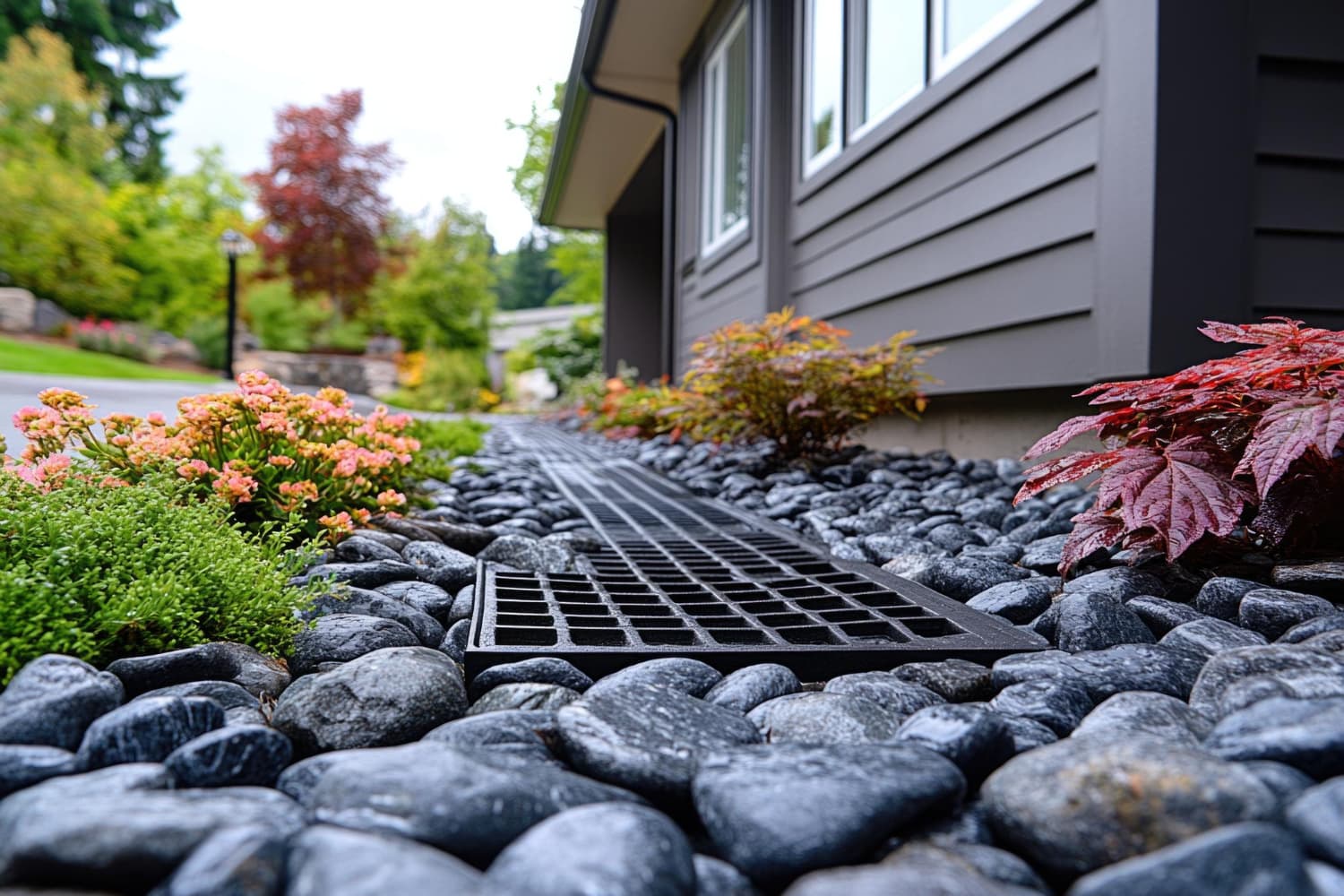
A catch basin, sometimes called a yard drain or area drain, is a surface-level collection point for runoff. It looks like a grated drain inlet set flush into the ground or at a low point in a paved or grassy area. Water flows across the surface and into the grate, where it drops into a sump below and then exits through a pipe to a designated discharge point.
Think of a catch basin as a drain in your yard that functions similarly to a floor drain in a basement or garage. It collects water that is already moving across the surface rather than drawing water up from the soil.
When a Catch Basin Makes Sense
Catch basins are the right choice when you have a defined area where large volumes of surface runoff collect quickly. Common situations include:
- A low spot in the lawn that collects sheet flow from surrounding areas
- A driveway or paved surface that channels runoff toward the garage or foundation
- Downspout discharge that overwhelms the surrounding area
- A pool deck or patio that sheds water toward the house
- Areas near a slope where fast-moving runoff pools at the base
Catch basins handle volume efficiently. Because the inlet is at the surface, they capture runoff quickly before it has a chance to saturate the soil. This makes them especially effective in yards with impervious surfaces nearby, like concrete driveways or large patios.
Homeowners in Edison, East Brunswick, and parts of Union County often deal with this exact scenario, where older properties have limited grading and runoff from paved areas has nowhere to go.
French Drain vs. Catch Basin: Side-by-Side Comparison
| Factor | French Drain | Catch Basin |
| Water type | Subsurface / groundwater seepage | Surface runoff and sheet flow |
| Best location | Lawn, near foundation, behind walls | Low spots, driveways, pool decks |
| Visibility | Mostly hidden below grade | Visible grate at surface level |
| Soil type fit | Works well with clay soil (common in NJ) | Works regardless of soil type |
| Outlet required | Yes, pipe to daylight or dry well | Yes, pipe to daylight or storm drain |
| Maintenance | Flush periodically, check for silt | Clean grate and sump annually |
| Average install | Moderate to complex | Straightforward to moderate |
Can You Use Both Together?
Yes, and in many NJ yards it makes a lot of sense to combine them. A common setup involves installing a catch basin at a low point to handle surface runoff, then connecting it to a French drain that handles subsurface seepage further upslope. Both systems share the same outlet pipe, reducing excavation and overall cost.
This combination approach is particularly effective in Middlesex and Somerset County properties where the terrain is gently rolling and properties experience both types of water problems depending on the season. During heavy spring rains, surface flow is the bigger issue. After the rain stops, slow-draining clay soil keeps seeping for days.
At Outdoor Hardscape, we assess both surface and subsurface conditions before recommending a system. There is no one-size-fits-all answer, and a solution that works well for a property in Princeton may not be the right fit for a yard in Piscataway with different grading and soil composition.
Drainage and Home Value in New Jersey
Good drainage is one of those improvements that does not always show up on a staging photo, but it absolutely shows up during a home inspection. Buyers in Central NJ are savvy about drainage issues, and a yard with chronic standing water or water-stained basement walls is a negotiating liability.
Investing in proper drainage infrastructure before listing, or simply as long-term home maintenance, protects your foundation, prevents soil erosion, reduces pest problems, and keeps your landscaping healthy. Healthy turf and well-maintained outdoor spaces consistently rank among the top return-on-investment improvements for New Jersey homeowners.
French drains and catch basins also protect adjacent hardscaping. Patios, retaining walls, and walkways installed without proper drainage can shift, settle, or fail prematurely when water pressure builds underneath them. Incorporating drainage during or after hardscape installation extends the life of those projects significantly.
What to Expect During Installation
The installation process for either system generally follows a similar sequence. Here is what a typical project looks like when working with our crew at Outdoor Hardscape.
Site Assessment
We walk the property, identify where water is coming from, where it is pooling, and where it needs to go. We check the grade, look at soil conditions, and consider proximity to the foundation, any existing hardscape, and municipal drainage options.
Utility Marking
Before any digging happens, we call NJ 811 to have underground utilities marked. This is a required step on every project involving excavation in New Jersey, and it protects both the crew and the homeowner.
Excavation and Installation
For a French drain, we excavate a trench to the appropriate depth for your frost line and soil conditions, lay the drainage pipe, pack in clean stone, and wrap the system in filter fabric to prevent silt intrusion over time. For a catch basin, we set the inlet box at the correct grade, connect the discharge pipe, and make sure the whole system has a clear path to the outlet.
Grading and Restoration
After installation, we regrade the disturbed area to restore positive drainage away from structures, seed or sod as needed, and clean up the site. If the drainage work is part of a larger hardscape project, we coordinate the timeline so concrete or paver work follows after drainage is confirmed and settled.
| Ready to Fix Your Yard Drainage? Outdoor Hardscape serves homeowners across Middlesex, Monmouth, Somerset, and Union Counties. Call us at 908-294-6296 | Visit outdoorhardscape.com | Email: edoutdoor790@gmail.com Ask about our current seasonal discounts on drainage installations. |
Local Drainage Considerations for Central New Jersey
Central NJ homeowners face a specific set of challenges that affect drainage decisions. The region sits within USDA Hardiness Zones 6b-7a, which means freeze-thaw cycles during winter can stress drainage pipe joints and shift settled stone over time. Annual maintenance checks, particularly in late winter after the ground has thawed, are a good practice.
Soil composition across Middlesex and Monmouth Counties tends to lean toward clay and clay-loam, especially in older subdivisions. Clay has very low permeability, which means water sits on top rather than infiltrating. This is exactly the condition that makes French drains so effective here, because they intercept that perched water before it saturates the root zone or works toward the foundation.
Many municipalities in Central NJ also have specific requirements around where drainage can discharge. Directing water onto a neighbor’s property or into a storm sewer without proper connection can create legal liability. Our team is familiar with the local ordinances across South Brunswick, East Brunswick, Edison, and surrounding townships, and we make sure every installation complies with local requirements.
How Outdoor Hardscape Handles Drainage Projects
Outdoor Hardscape is a fully insured hardscaping and landscaping contractor based in Kendall Park, NJ. We have been working in yards across Central New Jersey long enough to understand that drainage problems are rarely as simple as digging a trench and dropping in a pipe.
Every drainage project we take on begins with a thorough site evaluation. We consider the entire water story, where it originates, how it moves across or through your property, and what a complete solution looks like. Then we give you a straight answer about what needs to happen and what it will cost.
We install both catch basins and French drains as standalone projects and as integrated components of larger landscaping and hardscape builds. If you are also planning a patio, retaining wall, or outdoor kitchen, we can incorporate drainage into that scope of work so everything is coordinated from the start.
Our service area covers Kendall Park, Princeton, South Brunswick, East Brunswick, Edison, Piscataway, Monmouth Junction, and surrounding communities throughout Middlesex, Monmouth, Somerset, and Union Counties.
| Get a Free Drainage Consultation Stop guessing which drainage solution is right for your yard. Phone: 908-294-6296 | Website: outdoorhardscape.com | Email: edoutdoor790@gmail.com Serving Central NJ including Edison, Princeton, South Brunswick, Piscataway, and surrounding areas. |
Frequently Asked Questions
Q: What is the difference between a catch basin and a French drain?
A: A catch basin collects surface water through a grated inlet and directs it away through an underground pipe. A French drain, by contrast, uses a perforated pipe buried in gravel to collect subsurface water that seeps through the soil. Use a catch basin when water pools on the surface; use a French drain when saturated soil or groundwater is the main problem.
Q: How long does a French drain last in New Jersey?
A: A properly installed French drain can last 30 to 40 years or longer when the trench is lined with filter fabric to prevent silt intrusion. In Central NJ, where clay soils and freeze-thaw cycles are common, the quality of installation and regular maintenance checks every few years are the biggest factors in long-term performance.
Q: How deep does a French drain need to be?
A: Most residential French drains are installed between 18 inches and 24 inches deep, though the right depth depends on the specific problem being solved. A drain protecting a foundation needs to reach below the footing level, while a drain addressing lawn drainage may only need to sit 12 to 18 inches below grade. A site assessment will determine the correct depth for your property.
Q: Do catch basins require maintenance?
A: Yes. The grate and sump of a catch basin should be cleaned at least once a year, ideally in late fall before heavy rain season and again in spring. Leaves, debris, and sediment can clog the sump and reduce the system’s ability to handle runoff. Clearing the grate regularly is a simple task most homeowners can do themselves.
Q: Can a French drain fix a wet basement in NJ?
A: An exterior French drain installed around the perimeter of a foundation can significantly reduce the hydrostatic pressure that causes water intrusion through basement walls and floors. It is one of the most effective exterior waterproofing approaches for older homes in Central NJ. Interior French drains are also an option, but exterior systems are generally preferred because they address the source rather than managing water after it has already entered.
Q: How much does catch basin installation cost in New Jersey?
A: Catch basin installation in New Jersey typically ranges from $800 to $2,500 for a single basin depending on depth, pipe run length, outlet type, and site conditions. More complex systems with multiple basins or long discharge lines will cost more. Contact a local contractor like Outdoor Hardscape for an accurate estimate based on your specific yard and drainage goals.
Q: Is a French drain the same as a dry creek bed?
A: No, these are different solutions. A French drain is a buried system, mostly invisible once installed, that moves water through a perforated pipe. A dry creek bed is a decorative surface feature made of rock and gravel that channels visible water flow across the yard in a naturalistic way. Both can manage drainage, but a French drain handles subsurface water while a dry creek bed manages surface flow. Many yards benefit from combining both approaches.
Q: How do I know if I need a catch basin or French drain in my yard?
A: If water rushes across the surface and pools in a specific low spot during rain, a catch basin is usually the right starting point. If water soaks into the ground but stays saturated for days, or if you notice wet areas even when it has not rained recently, a French drain is likely the better fit. A drainage contractor can assess both surface and subsurface conditions and recommend the correct solution.